Castles, Temples and Ancient Capitals: Discovering Japan and South Korea by Sea
From Kanazawa's craft quarters to Hiroshima's Peace Memorial and the open-air museum of Gyeongju, this 13-night small-ship voyage reveals the cultural depth of East Asia.
4 October 2026
There is a particular pleasure in arriving at a historic Japanese city in the morning, spending the day among its temples and teahouses, and returning by evening to a ship that feels more like a private club than a cruise vessel. This 13-night voyage aboard the 118-passenger MS Island Sky offers exactly that rhythm — a carefully paced journey through some of the most rewarding corners of Japan and South Korea, sailing from Kanazawa to Kobe.
The itinerary casts a wide net. Ancient castle towns and World Heritage sites sit alongside reed-fringed wetlands and bonsai gardens; a modernist peace memorial shares the itinerary with a 9th-century Buddhist temple complex carved into a Korean mountainside. Few voyages in this part of the world manage such breadth without feeling rushed.
Before the ship departs, travellers spend time in Tokyo — a morning in the city takes in the Meiji Shrine and the venerable Sensoji Temple before a bullet train journey west delivers passengers to Kanazawa, where the MS Island Sky awaits.
What makes this voyage distinctive
Small-ship cruising is particularly well suited to Japan and South Korea. Ports that larger vessels cannot access, excursions that venture well inland, and an onboard atmosphere that encourages genuine conversation about what you have seen — these are the hallmarks of this style of travel. The Island Sky carries just 118 passengers, and the Noble Caledonia team, including a dedicated guest speaker, shapes each day's experiences with real depth. The result feels less like a package tour and more like an extended journey in expert company.
The voyage also crosses national boundaries in a way that rewards comparison. Japan and South Korea share deep threads of Buddhist heritage and an extraordinary reverence for craft and ceremony, yet each country has a strongly distinct character. Sailing between the two within a single itinerary allows those similarities and contrasts to emerge naturally.
Ancient castles and samurai streets
Kanazawa is one of Japan's most rewarding cities, and the voyage begins there in earnest. The narrow cobblestone lanes conceal samurai residences, geisha houses and craft galleries in equal measure, and the city has long been celebrated for lacquerware, Kutani pottery and intricate gold leaf work. Adjacent to the castle ruins, Kenroku-en Garden is ranked among Japan's top three — a masterpiece of considered landscape design.
At Matsue, often called the town of water for its position between lake and lagoon, the 17th-century castle is one of only a dozen original feudal fortresses still standing in Japan. A boat ride along the local canals adds a leisurely counterpoint to the sightseeing. Later, on Shikoku Island — one of Japan's more traditional and less visited islands — Ritsurin Garden, dating from the early Edo period, offers further evidence of the country's extraordinary horticultural heritage, alongside an introduction to the art of bonsai cultivation.
Shrines, temples and sacred places
Few sights in Japan are as immediately striking as the floating torii gate of Miyajima, and the island's shrines and pagodas more than justify the detour. Hiroshima, a short distance away, provides a profoundly moving counterbalance: the Peace Memorial is among the most significant historical sites in the world, and visiting it as part of a wider cultural journey gives the experience a particular resonance.
In South Korea, the Haeinsa Temple — first established in 802 AD — is considered one of the three great temples in the country. Tucked into the mountains above Masan, it houses the Tripitaka Koreana: 81,258 double-sided wooden blocks onto which the complete Buddhist scriptures were carved in the 13th century, commissioned in the hope of divine protection during the Mongol wars. It is an astonishing feat of devotion and craftsmanship, housed in the ancient Janggyeong Panjeon building to this day.
History written into the landscape
Gyeongju, the former capital of the Shilla Dynasty, is often described as the world's finest open-air museum, and a full day here begins to explain why. Hundreds of excavated tombs, temples and pagodas are scattered across the city, and the National Museum holds a remarkable collection of gold jewellery, metalwork and ceramics. A traditional Korean lunch and a performance of classical dance bring the culture vividly to life.
The walled fortress town of Naganeupseong, near the coastal city of Yeosu, offers a different kind of historical immersion — a UNESCO-listed settlement of over 59,000 square metres where some families have lived for generations, keeping traditional ways of life intact alongside their working craftsmen.
Coastline, wetlands and natural scenery
Yeosu — whose name translates simply as 'beautiful waters' — more than earns its title. The surrounding coastline and the option to travel by Skycube electric train to Suncheon Bay Wetland Reserve, one of South Korea's most significant ecological sites, gives wildlife enthusiasts and nature lovers ample reward. Reed beds, mudflats and migratory birds make for compelling boardwalk walking in a landscape quite unlike anything on the Japanese side of the itinerary.
Why the ship suits this voyage
The MS Island Sky is one of Noble Caledonia's two flagship vessels, built in Italy and designed to the same high specification as her sister ship, the MS Hebridean Sky. All-suite accommodation and a full-board arrangement — with house wine, beer and soft drinks included at meals — create a convivial, unhurried atmosphere that suits the pace of cultural travel. The small passenger count means excursions are never overwhelming, and returning each evening to a calm and familiar base makes the days feel richer rather than exhausting.
Who would enjoy this voyage?
This is a voyage for curious, independently minded travellers who want to go beyond the standard itinerary without sacrificing comfort. Those with an interest in history, architecture, religious heritage or garden design will find it particularly rewarding, but the combination of Japanese and Korean culture makes it broadly appealing to anyone drawn to East Asia. First-time visitors to the region and seasoned Japan travellers alike tend to find something new here.
From the bullet train to Kanazawa to the mountain path up to Haeinsa, this is a journey that stays with you. Explore the full voyage details on CruiseQuest to find out more.

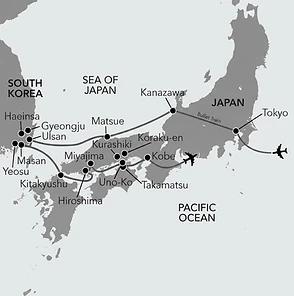
The voyage
Treasures of Japan & South Korea
Flights from London→Tokyo / Kanazawa / Matsue / Ulsan / Haeinsa / Yeosu / Kitakyushu / Hiroshima / Miyajima / Uno-Ko / Takamatsu / Kobe→Return to London
Explore further
This article was created with the assistance of artificial intelligence using publicly available voyage information. While every effort is made to keep content accurate and up to date, some details may not be 100% correct — please always confirm specifics with a travel advisor before booking.