Red Sands and Turquoise Seas: Exploring Wild Western Australia by Ship
From the Galapagos of the Indian Ocean to the coral gardens of Ningaloo, this 16-night expedition unlocks a remote and remarkable coastline few travellers ever see.
15 September 2026
Few stretches of coastline anywhere on earth remain as pristine, as vast, or as genuinely difficult to reach as the western seaboard of Australia. Ochre cliffs plunge into improbably blue water, remote island groups sit largely undisturbed, and the marine life is, in places, simply staggering. This is not a destination that rewards the hurried or the passive traveller.
For those willing to venture properly off the beaten track, the rewards are extraordinary: UNESCO World Heritage wilderness, coral reefs among the world's finest, seabird colonies numbering in the millions, and an indigenous and maritime history that stretches back centuries. This 16-night expedition with Noble Caledonia, sailing aboard the Coral Adventurer from Fremantle to Broome, opens up all of it.
Beginning with two nights in Perth — with a guided walk through Kings Park and its remarkable botanical gardens above the Swan River — the voyage moves northward through a succession of natural world highlights that build, one upon the next, into something genuinely memorable.
What makes this voyage distinctive
The western Australian coast is not simply remote — much of it is inaccessible to conventional cruise ships. Shallow reef systems, narrow channels and uncharted island groups demand a vessel of particular capability, and a team with genuine expertise. This expedition delivers both. Rather than sailing between well-worn ports, the itinerary is built around natural and historical landmarks that most travellers will never encounter: a pearl farm on a crayfishing island, a massacre site on a reef barely above sea level, a dugong feeding ground far from the nearest road. The focus throughout is on authentic discovery, guided by an onboard expedition team.
The Abrolhos Islands: the Galápagos of the Indian Ocean
Three full days are devoted to the Abrolhos Islands — 122 islands grouped into the Wallabi, Easter and Pelsaert clusters — and it quickly becomes clear why. This is where tropical and temperate ocean currents converge, creating a marine environment of remarkable richness. Australian sea lions haul out on rocky shores; bottlenose dolphins work the channels; over 90 species of seabird have been recorded here.
The history is equally gripping. On Beacon Island, also known as the Island of Angry Ghosts, the wreck of the Dutch vessel Batavia in 1629 preceded one of the most violent mutinies in maritime history. The Batavia Memorial cairn still stands, and the coral pits where the ringleader was held before his execution remain visible. At the Easter Group, the sea lion colony at Little Sandy Island is the largest in the Abrolhos, and snorkelling opportunities — at sites including Squid Hole and the Anemone Lump — are outstanding. The Pelsaert Group adds a different dimension entirely: a visit to Liddon Pearl Farm and an introduction to the crayfishing industry from a family that has worked these waters for four generations.
Shark Bay and the Ningaloo Coast: World Heritage Wilderness
Shark Bay holds the distinction of being the first site in Western Australia to receive UNESCO World Heritage status, and it earns it. The Francois Peron National Park offers a landscape where rust-red desert cliffs meet turquoise shallows, and the bay is home to an astonishing 35 per cent of all Australian bird species. Historic Cape Inscription marks the spot where Dutch navigator Dirk Hartog made landfall in 1616 — one of the earliest recorded European contacts with the Australian continent.
Ningaloo Reef, explored during a day at Cape Range National Park, is one of the longest fringing reefs on the planet, and its unusually shallow continental shelf means deep-ocean species and coastal communities exist in close proximity. Snorkelling at Turquoise Bay is a highlight; the Ningaloo Coast is also one of the Indian Ocean's most important turtle nesting rookeries. The small town of Exmouth provides a base for those wishing to visit the Vlamingh Head lighthouse or the Ningaloo Centre.
Islands of the North: Muiron, Montebello and Dampier
The final island sequences are among the most visually dramatic of the voyage. The Muiron Islands, roughly ten nautical miles off the Northwest Cape, are celebrated for their soft corals, gorgonians, and the reliable presence of turtles and manta rays. Serrurier Island, further northeast, shelters seagrass beds that sustain local dugong populations. The Montebello Islands — more than 250 limestone islets — are classified as an Important Bird Area, while the 42-island Dampier Archipelago, 25 of whose islands are designated nature reserves, provides a final, vivid flourish: iron-red rock rising from impossibly clear water.
Culture, Heritage and Indigenous History
This is a coastline with deep human stories layered beneath its wild exterior. The Malgana people of Shark Bay and the Yaburara people of the Dampier Archipelago have connections to these lands that long predate European contact. The voyages of Dampier, Dirk Hartog, Baudin and Freycinet added further chapters, and the crayfishing and pearling industries of the Abrolhos introduced yet another strand. The expedition team weaves these histories into landings and briefings throughout the voyage.
Why the ship suits this voyage
The Coral Adventurer was purpose-built in 2019 for exactly this kind of travel. Carrying a maximum of 120 passengers, with a shallow draft and high manoeuvrability, she can access reef systems and island anchorages that are entirely off-limits to larger vessels. A fleet of Zodiacs and two distinctive Xplorer tenders extend that access further still, landing passengers directly onto remote beaches and reef platforms. The atmosphere on board is relaxed and informal, with an excellent Australian crew whose hospitality reflects the spirit of the region itself.
Who would enjoy this voyage?
This is an expedition in the truest sense, and it suits travellers who prefer the substance of a place to its surface. Keen snorkellers, birdwatchers, wildlife enthusiasts and those with an appetite for maritime and indigenous history will find the itinerary richly rewarding. A reasonable level of mobility is helpful for landings, but the focus is always on engagement rather than endurance. Like-minded, curious companions and expert guidance are part of the experience.
Western Australia's remote coast is one of the great undiscovered journeys — and this voyage may be the finest way to experience it. Explore the full itinerary on CruiseQuest to find out more.

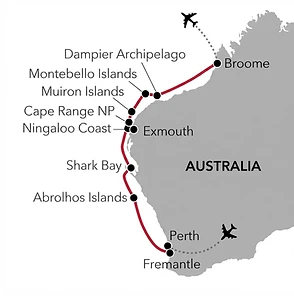
The voyage
Wildlife & Wonders of Western Australia
Flights from London→Perth / Fremantle / Abrolhos Islands / Shark Bay / Ningaloo Coast / Exmouth / Cape Range National Park / Muiron Islands / Serrurier Island / Montebello Islands / Dampier Archipelago / Broome→Return to London
This article was created with the assistance of artificial intelligence using publicly available voyage information. While every effort is made to keep content accurate and up to date, some details may not be 100% correct — please always confirm specifics with a travel advisor before booking.